


Last weekend, I hosted a meditation class for six-year-old Muslims in preparation for Ramadan. Unfortunately, meditation is often misunderstood in our community. In this newsletter, however, I want to help you explore it as a tool to deepen your connection with Allah.
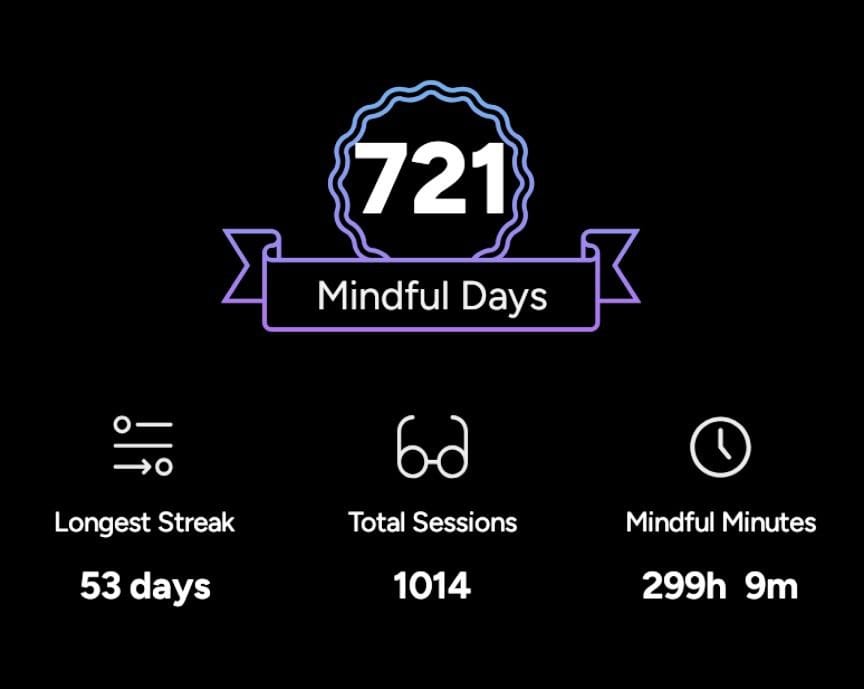
I have been meditating since ~2013 and recently have completed 1,000 meditation sessions on the Calm app [Get a 30-day free trial here]. For the past 6 years, I have also been teaching meditation to high-achieving Muslims as a tool to regulate their emotions and re-centering their relationship with Allah [You can get access to Zahra's "7 days to a positive mindset" Islamic meditation series inside our private community. This is a great series for Muslims looking to start a meditation practice]. During this time, I have seen two common misconceptions about meditation that prevents Muslims from fully benefitting from the practice.
The first is that meditation is often associated with “new age” spirituality, manifesting, or other non-Islamic traditions which can make Muslims skeptical of meditation. We assume that because some introduce polytheistic practices to meditation, such as chanting "god" names in Sanskrit, then it must not belong to us. However, meditation has deep roots in the Islamic tradition. The Arabic term for meditation, muraqaba, means to observe (or to be watchful). The Prophet Muhammad PBUH would famously seclude himself in a meditative state before prophethood in the cave of Hira for weeks at a time, and it is in that state that he received the first revelation during the blessed month of Ramadan.
Just because other traditions use something that is beneficial, doesn't mean that we shouldn't use it as well. For example, other traditions pray (supplicate) to God or the "universe". This doesn't mean that they have a monopoly on that practice, or that we shouldn't pray to God for things. As a general rule, I believe that anything that benefits humanity has a root in Islam.
Second, and more importantly, many people misunderstand the purpose of meditation. When I first started meditating, I meditated to get good at meditating. Over time, I realized that meditating for its own sake is like practicing a sport to be good during practice but not the actual game.
Here's the spiritually intelligent reframe:
The point of meditation isn't to get good at sitting still cross-legged on a on a cushion, but to get good at living life with full awareness.
Why do we fast?
"O you who have believed, decreed upon you is fasting as it was decreed upon those before you, so that you may attain taqwa (God consciousness)." [2:183]
We have heard the above verse numerous times in the weeks leading to Ramadan, but sadly we rarely hear it (or reflect upon it) once Ramadan starts.
We hear this verse frequently before Ramadan, but rarely reflect on it during the month itself. Taqwa is the goal of fasting and, in truth, the aim of every act of worship. Prayer, charity, sacrifice, pilgrimage, truthfulness, restraint, etc are all meant to cultivate a deeper awareness of Allah.
Here are just a few examples from the Qur'an on taqwa being the purpose of worship, and as you connect with the Qur'an during this blessed month, I encourage you to pay attention when taqwa is mentioned.
"Righteousness is not that you turn your faces toward the east or the west, but [true] righteousness is [in] one who believes in Allah, the Last Day, the angels, the Book, and the prophets and gives wealth, in spite of love for it, to relatives, orphans, the needy, the traveler, those who ask [for help], and for freeing slaves; and [who] establishes prayer and gives zakah; [those who] fulfill their promise when they promise; and [those who] are patient in poverty and hardship and during battle. Those are the ones who have been true, and it is those who have attained taqwa" [2: 177]
"Their meat will not reach Allah, nor will their blood, but what reaches Him is taqwa from you. Thus have We subjected them to you that you may glorify Allah for that [to] which He has guided you; and give good tidings to the doers of good." [22:37]
"And hasten to forgiveness from your Lord and a garden as wide as the heavens and earth, prepared for those who have attained taqwa: Who spend [in the cause of Allah] during ease and hardship and who restrain anger and who pardon the people, and Allah loves the doers of good." [3:133-134]
The Qur’an repeatedly ties righteousness to taqwa. In Surah Baqarah alone, the term appears at least 30 times. In its simplest form, taqwa reminds us that what reaches Allah is not the outward form of our actions, but the taqwa behind them (22:37). If taqwa is heightened awareness of Allah, then meditation is a tool to cultivate and deepen that awareness.
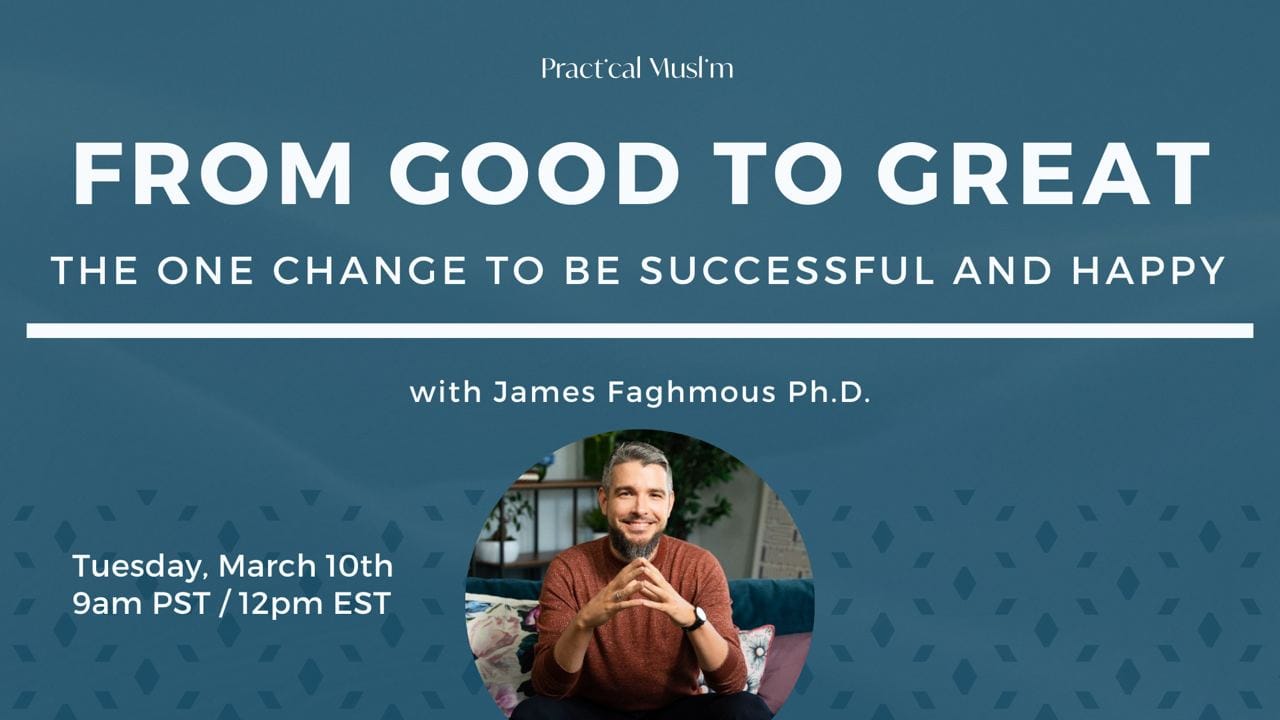
Join me on March 10th at at 9am PST for my "From Good to Great" workshop. In this live session, I will walk you through a simple framework to maintain your focus and discipline beyond Ramadan. Get complimentary access by joining 3500+ inside our private community. Replay is available for all who register.
Meditation as a tool for taqwa
In my workshop "Your Best Ramadan Yet" [You can watch the full workshop for free inside my private community] I discuss the three levels of fasting: physical, mental, and spiritual. At its most basic level, fasting trains us to delay a response. You feel hunger. You do not eat. Even if you find your favorite chocolate bar while alone, you delay your response (eating) until sunset. It's important to note that you are not denying your feeling of hunger while fasting. You're merely postponing your response. This is a critical distinction. As a community, we are often taught to suppress or deny our feelings instead of delaying a response. The Prophet PBUH taught us this technique in many instances including in the famous hadith:
“If one of you becomes angry while standing, let him sit down. If the anger leaves him, well and good; otherwise, let him lie down.” [Abu Dawood]
The Prophet PBUH did not condemn the feeling of anger, but rather instructed us to delay our response to the feeling by performing a "pattern interrupt" [In my Spiritual MBA program, I walk you through the 3 most effective types of pattern interrupts for Muslims]. Meditation is the tool to strengthen our ability to delay a response to thoughts and emotions as they occur in daily life.
Meditation helps us delay our reaction to fear, jealousy, envy, anger, etc. until a later time when we have had a moment to examine (or observe) our thoughts clearly. In fact, meditation is an essential tool of the two deeper dimensions of fasting: the mental and spiritual fasts.
As I mentioned earlier, the Arabic term for meditation is muraqaba and it is a fitting name, as the primary skill that we gain from meditation is the ability to observe our thoughts as separate from us. When we depersonalize thoughts, we are able to see them for what they are: random words in our mind. This allows us to react to them in a more detached and God-centered manner. Imagine looking at the sky. Planes, clouds, birds, and dragons pass through it (hey, you might be reading this from Middle Earth!). You would never confuse them for the sky itself. Likewise, your mind is the sky. Thoughts are passing clouds. They appear and disappear. They do not define the sky, and they do not define you.
Practical meditation
Before I dive into some basic meditation techniques, I'd to answer a question first: How does sitting still on a cushion practically help you as a founder, professional, or parent? Sitting quietly for ten minutes does not directly make you a better executive or parent. What changes you is the ability to observe your internal state without being controlled by it.
Consider someone who has just moved into the C-suite for the first time. The scope of responsibility expands overnight. Every message feels urgent. Every decision feels high-stakes. Without the proper spiritual tools, fear, anxiety, and impostor syndrome quickly become the main drivers for decision making. This is where a promotion become a demotion as our quality of life suffers. Cultivating a meditation practice helps the executive regulate their emotions and teams trust leaders who are regulated. But more importantly, this executive will be able to discern between fear-based thoughts and not act on them.
Another example: an entrepreneur purchases a business, only to watch customers cancel in the first few months after the acquisition. Revenue dips and the mind spirals into catastrophic narratives: “I made a mistake. This will fail. I’ve embarrassed myself.”
Without awareness, panic will dictate actions: prices are slashed out of fear, there is a frenzy to hire a "marketing consultant", staff are blamed, etc. With a meditation practice, the entrepreneur sees those thoughts as only thoughts, not objective reality. They name the fear and turn it over to the All Knowing. The situation may still be difficult, but it is handled with faith instead of desperation.
Finally, consider a parent at the end of a long day. A child spills something or talks back. The natural response is the tightening of the body and shouting. This response is generally due to the thought: "I've been working all day and I am tired, why can't you just do I say?!!" However, meditation creates a small but powerful gap where we choose to not respond immediately to this thought. In that gap, the parent notices the surge of anger and chooses how to respond. Over years, those small moments shape the emotional climate of a home.
In all of these examples, meditation doesn't suppress or ignore the emotion as much as it helps us redefine our relationship (and reactions) to emotions, which is at the heart of high-performance.
Your choice this Ramadan
This Ramadan, I encourage you to observe and consciously choose between escapism or mindfulness as this is the greatest choice you can make for your faith, career, and relationships.
Stillness is uncomfortable at first because it exposes what we have been avoiding. There is a famous study that showed that men are more willing to shock themselves with electricity rather than sit with their own thoughts. But once we get used to that discomfort, we realize we are never alone. Within that realization we can let go of relying on our own strength and intellect, and surrender to the Eternal One.
Escapism is easier. When we feel anxious, or scared, and jealous we reach for food, or social media, or endless YouTube videos. Some turn to substances. Others bury themselves in work. Even constant religious busyness can become a distraction if it prevents honest reflection.
The cost of escapism is subtle. Years pass in partial presence. We sit at dinner while mentally elsewhere. We scroll through life rather than inhabit it. Difficult emotions are numbed rather than understood. That's the greatest waste. Difficult emotions aren't a virus we ought to avoid. They are subtle message from Allah to pay attention, to reflect, and to respond in faith. The danger of escapism is that it compounds negatively. We pay "interest" on every decision that we delay because it is making us uncomfortable. Each delayed decision, makes the next decision worse. Each delayed decision, has an opportunity cost where we can't pursue new projects because we never finished previous ones. Each delayed decision keeps us stuck in the past instead of creating our future.
Mindfulness allows us to feel what is there without immediately anesthetizing it. The real value of mindfulness is not productivity or even calmness. It is that we do not waste our lives running from the present moment.
If we are always escaping, are we fully living?
A first step into meditation
The biggest barrier to getting started with meditation is the misconception that to meditate means to sit still with your eyes closed while humming "Om". That is one way to meditate, but not the only way. Here are a few simple ways to start building your meditation practice to reap the benefits of mindfulness.
In Salah
If you pray the first daily prayers, then the easiest way to meditate is to deepen your daily prayers. Salah is a meditative experience but recently it has been turned into a worship checklist item instead of a tool for deep connection. This is in contrast with the example of the Prophet PBUH and the companions (may Allah be pleased with them). One such exam is a famous story (often attributed to Ali (may Allah be pleased with him):
ʿAli (may Allah be pleased with him) was struck by an arrow. It was said: “Do not remove it until he prays, for when he prays he will not feel it.” So when he entered prayer, the arrow was removed and he did not feel it.
Here we can see that the prayer was such a deep meditative experience that he didn't feel the arrow being removed.
Another benefit of adding mindfulness to your prayer if you are already praying is that you don't have to create a new habit, just expend on an existing one.
The simplest way to add mindfulness to your Salat is to radically slow down the prayer by introducing deep, mindful breaths. The idea is to approach the prayer as if you are in a meeting with your dearest friend and you want to prolong that meeting for as long as you can. The simplest way to increase mindfulness in the prayer is to add a deep breath at the beginning and end of each position. For example, before starting to recite al-Fatiha, you would take a deep inhale from your nose and a deep exhale from your mouth.Then you recite Al-Fatiha in another surah. Before kneeling, you will again take a deep inhale from the nose and a slow exhale from the mouth. You will then continue to "sandwich" each position by an inhale and an exhale at the beginning and before moving on to the next position (e.g. ruku', sujood, etc)
The Jedi level of this practice is to introduce an inhale and exhale between each utterance. For example, you would take an inhale and an exhale between each verse of Al-Fatiha and subsequent surah (e.g. "al hamdulilahi rabbil 'alameen" inhale/exhale "ar-Rahmaan ar-Raheem", etc.) Then when you move to ruku', you would take an inhale and exhale between each utterance of "Subhana Rabbi al-Azim". There is no one way to do this and you can experiment with what works for you. The key idea is to introduce the breath as a means to be more present and not race through the prayer. If you cannot commit to this practice during the mandatory prayer, consider doing it in an optional prayer.
In Sujood
Technically, this could have been in the Salah section above, but having mindfulness in Sujood, is such a profound experience that it deserves its own section. The goal is to remain in sujood, in awareness of Allah subhanahu wa ta'ala, for as long as possible. This is why I recommend that you try this in a voluntary prayer (tahajjud is a great time for this) where you do not need to keep count of the number of rakahs that you've performed. This is my process
- Enter sujood and take 2-3 deep breaths
- Start by giving thanks (hamd) for all for 1-3 things. Repeat each thanks 3 times separated by one inhale and exhale. For example "al hamdulilah for my health to stand in prayer" inhale + exhale "al hamdulilah for my health to stand in prayer" inhale + exhale "al hamdulilah for my health to stand in prayer"
- Send peace and blessings upon the Prophet PBUH x 3 with each salaam separated by an inhale and exhale
- Ask for something sincerely x 3 with each round separated by an inhale and exhale. Try picturing and feeling the thing you are asking for. Try feeling the Unlimited Power of Allah and how nothing is impossible with Him
- Ask for as many things as you want or switch it up and make istighfar (forgiveness) instead.
In Dhikr
Like Salah, dhirk, or "remembrance", has been largely turned into a checklist devoid of mindfulness. This is probably the easiest place to practice mindfulness if you already have a habit of daily dhikr. Just like with the prayer, all you have to do is introduce a mindful breath between each utterance.For example, you would say: "SubhanAllah," take a deep inhale and exhale. Then, "SubhanAllah" and inhale and exhale until you do so 33 times. It can also be helpful to not count and simply repeat a phrase for as long as it feels sufficient to not distract yourself with keeping count.
Reflecting
Although it is mentioned often in the qur'an, reflection, is a highly underutilized tool in this modern age. Reflection or contemplation doesn't only mean to sit in quiet reflection, but it can also mean active reflection, as working through and interacting with a piece of spiritual literature. This can be done by pausing to internalize rather than rushing to complete the Qur'an or any text that moved you. Another powerful example I got from the book "The Monk Who Sold His Ferrari" is to sit with a single flower or leaf for five to ten minutes, observing its detail and allowing your attention to be engrossed in the beauty of Allah's creation.
These are just a few ways to get started with meditation. Reply to this email to let me know which approaches work best for you. Start small. Be consistent. Let Ramadan become a training ground for awareness, not merely a checklist of actions. Fasting teaches us to delay physical impulses. Meditation teaches us to delay emotional impulses. Together, they deepen our taqwa.
I want to leave you with this video of Eileen Gu, the most decorated free skier in Olympics history where she describes: “I spend a lot of time in my head. But it’s a nice place to be.” That's point of meditation: to be able to see thoughts for what they are, and not let them shape who we are. This is exactly, what I do as a coach, I help professional Muslims and entrepreneurs strengthen their mental hygiene so that not only they perform at a high-level, but they also do so with a high quality of life (i.e. their mind becomes a nice place to be). If you're interested in working 1:1 with me, book a brief call with me here.
May this Ramadan be one in which we are not only fasting from food, but also fasting from reactivity, distraction, and escapism.
Peace and blessings
James
1. If you enjoy these reminders, support my work by pre-ordering my upcoming book "Spiritual Intelligence: 10 Lost Secrets to Thrive in the Age of AI" and get exclusive access to a chapter before the general public
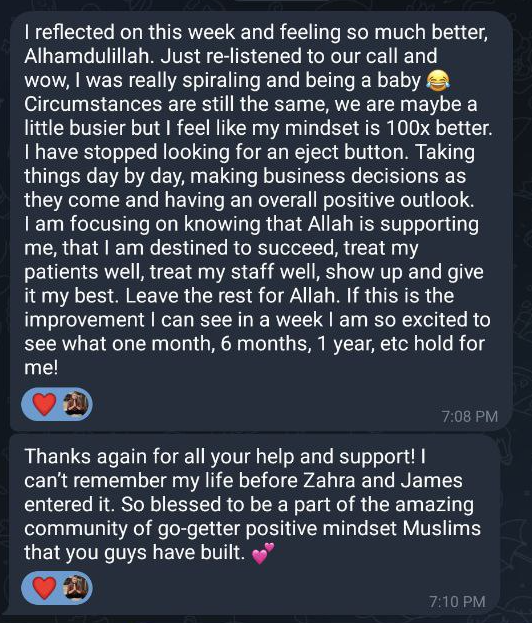
2. Join 3500+ other Muslims in my private community off of Big Tech platforms and get access to weekly live events.
3. Master manifesting for Muslims in my most popular course "Friction to Flow" and get $290 off as a newsletter subscriber!