


I've been struggling with a difficult balance recently: that of strong desire and detachment.
I noticed in the past 3 years that my desire for certain goals and achievements has waned. At first, I brushed it to just getting detached from worldly achievements. But then it dawned on me that part of my lack of desire is actually a sign of a fear of failure: If I don't desire something too much, it's not a big deal if I don't achieve it 🤷♂️
While we could all use a stronger desire grounded in faith, I've also found it hard to tip-toe the line between strong desire and control. In the past, I would try to control everything (in part because of my turbulent childhood): timelines, relationships, results, etc. However, the tighter I held, the more anxious I felt. Ironically, the more I tried to control things, the less control I had!
Here's the spiritually intelligent reframe:
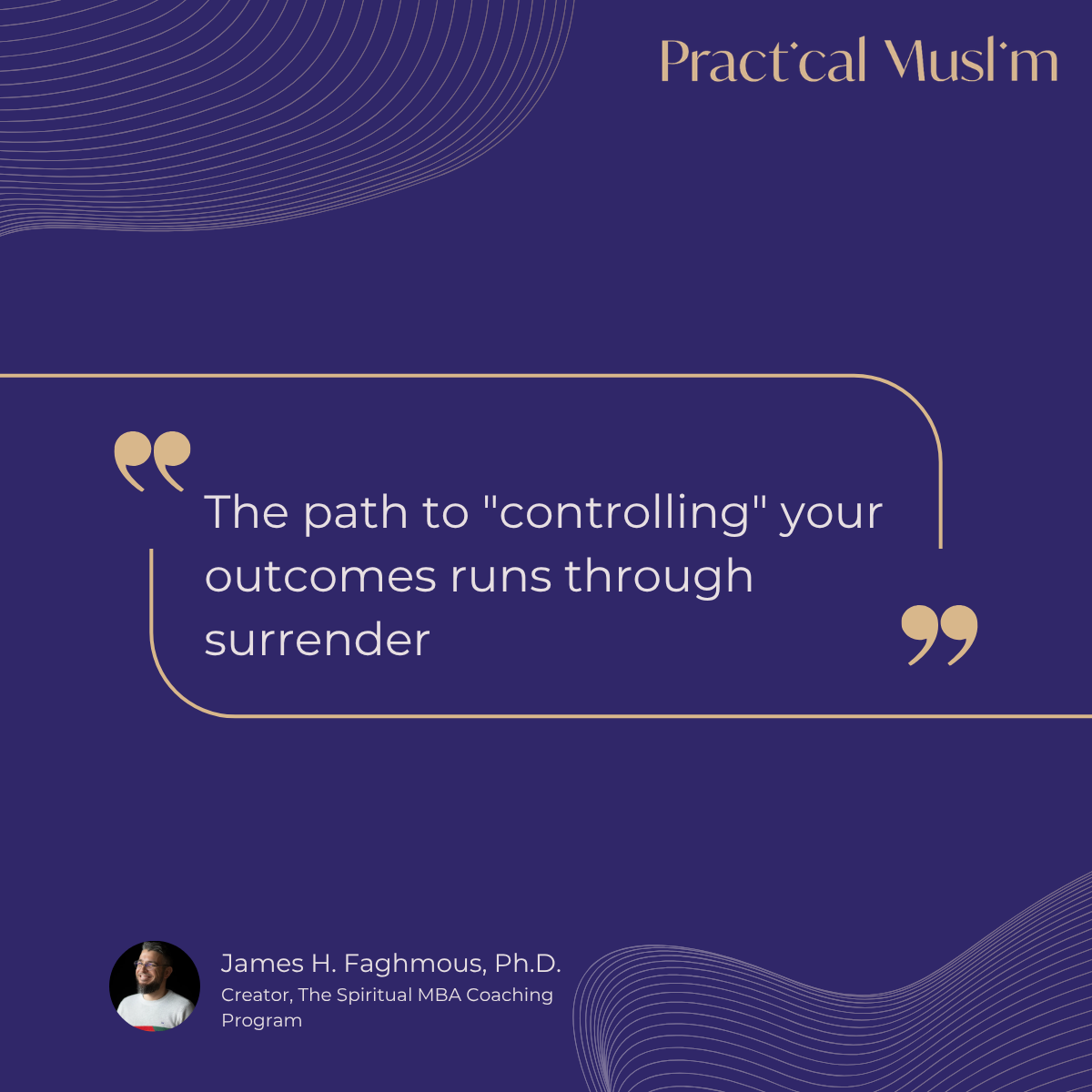
The path to "controlling" your outcomes runs through surrender.
Misunderstanding Surrender
The word surrender often conjures the image of waving of a white flag. However, true surrender doesn't mean giving up. It's actually the skill of recognizing what was never ours to control while remaining peacefully content.
Another extreme of the misunderstanding of surrender is renouncing responsibility: "If Allah controls everything, what's the point of my actions?" But true surrender doesn't mean we don't take responsibility but rather we focus on taking full responsibility for our part, and not meddle in areas that are not our responsibility. True surrender doesn't mean we give up effort, it means that we will let go of the illusion that effort guarantees an outcome.
There is a prayer known as the Serenity Prayer that summarizes true surrender perfectly:
God, grant me the serenity to accept the things I cannot change. The courage to change the things I can, and the wisdom to know the difference
Surrender is the wisdom to know what is our responsibility and what is God's.
The Two Circles
In his book "The 7 Habits of Highly Effective People" author Stephen Covey (based on an older book "How to Win Friends and Influence People") outlines the different types of events of our lives and groups them into three circles:
- Circle of Control: Direct power over your own actions, thoughts, and behaviors (e.g., your daily routine, attitude, or specific work tasks).
- Circle of Influence: Indirect power to shape outcomes or affect others (e.g., encouraging teamwork, influencing workplace culture, or guiding a child’s behavior).
- Circle of Concern: External factors beyond your power, such as global economic trends, the weather, or other people’s opinions.
I use a simpler model with my coaching clients. Take a piece of paper and draw two circles:
Circle One: Everything in your control. Your effort. Your intention. Your character traits (or self-image). Your choices.
Circle Two: Everything outside your control. Others' decisions. Market conditions. Timing. Outcomes.
If you are feeling out of balance at the moment: working too much with little to show for it, constant low-level worry and anxiety, or being stuck in analysis paralysis, then chances are you're spending way too much energy trying to control Circle Two. Surrender simply means redirecting your energy from Circle Two to focus fully on Circle One.

Join me and Zahra Aljabri for this 4-week workshop on heart-centered selling to be able to sell confidently and with integrity. Make (at least) two sales by the end of the four weeks, regardless of your price-point (and yes, we will coaching you on how to price your product or services). Sign up now, and get immediate access to session 1 and join us live on Tuesday, July 7th for session 2.
Practical Surrender
The Prophets were the perfect examples of spiritual surrender.
The greatest example in the Qur'an (IMHO) is that of the Prophet Musa (PBUH). After his exile and arrival in Madyan, he was lost, scared, and confused so he surrendered to Allah in one of the most famous du'as:
So he (Moses) watered ˹their herd˺ for them, then withdrew to the shade and prayed, “My Lord! I am truly in ˹desperate˺ need of whatever provision You may have in store for me [28:24]
فَسَقَىٰ لَهُمَا ثُمَّ تَوَلَّىٰٓ إِلَى ٱلظِّلِّ فَقَالَ رَبِّ إِنِّى لِمَآ أَنزَلْتَ إِلَىَّ مِنْ خَيْرٍۢ فَقِيرٌۭ ٢٤
Many Muslims recite the du'a when they seek marriage. But the power of this du'a isn't in the exact words but rather in the energy and the heart-set of our Prophet Musa (AS). His dua'a meant: ya Allah I am giving up all preconceived notions of what's good for me and what I desire and I am fully surrendered to whatever you will for me.
Similarly, before every major decision, the Prophet ﷺ would pray Istikhara (literally "seeking good.")
The prayer includes:
"If this matter is good for me in my faith, my livelihood, and my affairs, then ordain it for me and make it easy. But if it is bad for me, then turn it away from me and turn me away from it."
As we discuss in the module on decision making in my Spiritual MBA program, Istikhara requires complete effort and complete surrender. This is the 200% principle. I need to give 100% effort and 100% trust.
Surrender vs. Resignation
It's easy to confuse surrender and resignation, so here some simple rules of thumb:
Resignation is passive. "Whatever happens, happens." Surrender is active. "I'll do everything possible, then release the outcome."
Resignation comes from exhaustion. Surrender is an active choice.
Resignation believes nothing matters. Surrender believes everything matters, but not everything is yours.
The Surrender Practice
Tomorrow morning, identify your biggest source of anxiety. The thing you're gripping most tightly and give this practice a try:
- Have I done what's in my control? We are not seeking perfection. Done is better than perfect. If you feel you haven't done everything that's in your control, ask yourself "What is one thing I can do today to take care of this?". Identify that one thing, and do it. Don't procrastinate.
- Am I trying to control the uncontrollable? Others' opinions. Future conditions. Past decisions. If so, remind yourself that Allah is in control of the outcome, not people.
- Can I release this to a Higher Power? Can I recognize and accept the limits of my effort intellect. I am not abondoning responsibility. I am just turning this to the Most High.
Then physically open your hands and exhale. That's surrender.
The Three Stages of Surrender
Stage 1: Forced Surrender
Life forces you to let go. The deal falls through. The promotion doesn't come. The plan fails. You surrender because you have no choice.
Stage 2: Strategic Surrender
You recognize that surrender serves your interests. Letting go creates space for better things. You surrender because you know at an intellectual level that it works.
Stage 3: Spiritual Surrender
You understand that surrender is not a strategy but a state. Not something you do but something you are. You surrender because that's the true meaning of islam: to peacefully surrender to what is (God).
The Quranic Promise
"It may be that you dislike something and it is good for you, and it may be that you love something and it is bad for you. Allah knows, and you do not know" (2:216).
The key to surrender is to accept that we have limited perception. Our senses, our intellect, our "data" are incomplete. Our brain cannot access deeper realities that go beyond reason. This means that we can never have perfect information, no matter how hard we try.
Surrender is the acceptance that we cannot rely completely on our intellect. The reason we are exhausted is because we are over-exerting ourselves mentally at tasks we have no business meddling with.
Surrender is giving over to wisdom greater than our own.
Your Surrender Invitation
What are you gripping so tightly it's cutting off circulation to your heart, the true center of "intelligence"?
What outcome are you forcing that wants to flow?
What would become possible if you did everything in your power, then surrendered everything beyond it?
Reclaim your power by letting go of what you cannot control.
May Allah's Peace be with you,
James
1. If you enjoy these reminders, support my work by pre-ordering my upcoming book "Spiritual Intelligence: 10 Lost Secrets to Thrive in the Age of AI" and get exclusive access to a chapter before the general public
2. Join 3500+ other Muslims in my private community off of Big Tech platforms and get access to weekly live events.
3. Master manifesting for Muslims in my most popular course "Friction to Flow" and get $290 off as a newsletter subscriber!